
The Honey Trap
VS
Families dealing with dementia are often desperate for hope.
And where there is desperation, there is always someone selling a miracle.
A capsule. A protocol. A hidden cure. A “doctor-approved” video. A fake celebrity endorsement. A limited-time offer wrapped in soft lighting and medical-sounding nonsense.
This is the honey trap.
It does not begin with obvious fraud. It begins with relief.
It sounds compassionate. It sounds natural. It sounds like someone finally understands your fear.
And that is exactly why it works.
I’m bringing this piece into MiM because families navigating memory loss need more than routines, care plans, and paperwork. They need scam literacy. They need a pause button. They need someone willing to say: hope is sacred, but it should not come with a checkout cart and a countdown timer.
A warning for families navigating memory loss, cognitive decline, and Alzheimer’s fear
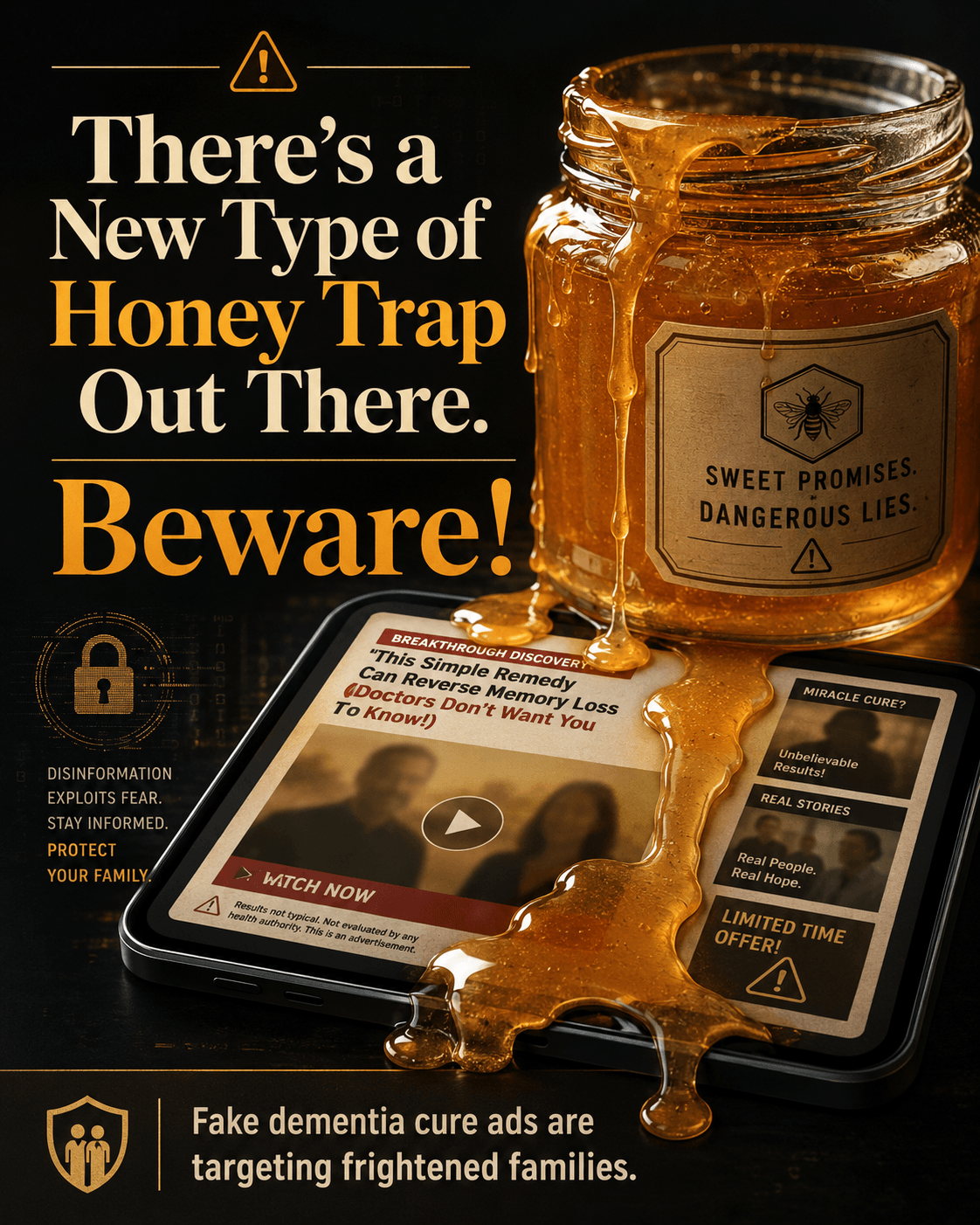
There is a special kind of cruelty in selling false hope to frightened families.
Not ordinary cruelty. Not garden-variety internet nonsense. Something uglier.
The kind that waits until a spouse is scared, a daughter is exhausted, a son is Googling symptoms at midnight, or someone with memory changes is quietly wondering whether they are disappearing.
Then it appears.
A fake-looking news article.
A familiar celebrity face.
A famous doctor’s name.
A billionaire philanthropist.
A miracle ingredient sitting in your kitchen.
And the promise that Alzheimer’s, dementia, or cognitive decline can be reversed with a simple “ritual” if only you watch the video before it disappears.
That is not medicine.
That is predation with a landing page.
Recently, I came across one of these pages. It used the names of Steve Martin, Martin Short, Bill Gates, Dr. Sanjay Gupta, CBS Mornings, and others to suggest that a natural “honey ritual” could reverse memory loss or cognitive decline.
The page claimed people could feel sharper in one or two days.
It suggested traditional medicine had failed.
It hinted that powerful interests were trying to suppress the truth.
It used fake urgency, fake comments, fake celebrity credibility, and the oldest trick in the scammer’s handbook:
Make people afraid.
Then sell them certainty.
Let’s be very clear.
There is no credible evidence that a “7-second honey ritual” reverses Alzheimer’s disease.
There is no kitchen shortcut that restores memory in one or two days.
There is no legitimate dementia breakthrough that needs to hide behind fake celebrity interviews, countdown pressure, emotional manipulation, and “watch this before it’s taken down” hysteria.
Real science does not behave like a carnival barker in a lab coat.
Real medical information does not need to impersonate a morning show.
Real help does not start by frightening families into clicking a video.
And this matters because families dealing with memory changes are already carrying enough.
They are carrying grief.
They are carrying confusion.
They are carrying paperwork, appointments, medication lists, family conversations, safety worries, driving questions, legal planning, financial planning, and the terrible emotional weather of not knowing what comes next.
They do not need scammers climbing through the window dressed as hope.
This is one reason MiM exists.
MiM is not here to sell a cure.
MiM is not here to replace doctors.
MiM is not here to promise that memory loss can be reversed by honey, berries, pills, powders, rituals, secret videos, or celebrity-endorsed nonsense wearing a cheap hat.
MiM is here for the part of the journey that often gets ignored.
The daily-life part.
The “what do we do now?” part.
The early-stage gap between noticing changes and needing more formal care.
The part where families need structure, communication, routine, connection, practical tools, and less panic.
That is not flashy.
It does not come with a miracle countdown clock.
It does not promise to clear “rust” from the brain by Tuesday.
But it is real.
And real matters.
Here are the warning signs I want every family to know.
If a page claims dementia or Alzheimer’s can be reversed quickly, stop.
If it uses celebrity names to sell a product or video, verify it somewhere else before believing a word.
If it says doctors do not want you to know something, pause.
If it says the video may be removed soon, pause harder.
If it promises dramatic results in days, put the credit card down.
If it uses phrases like “natural protocol,” “secret ritual,” “pharmaceutical lobby,” or “suppressed cure,” remember that fear is being used as the sales funnel.
And if the page is designed to make you feel foolish for not clicking immediately, that is not education.
That is pressure.
The most dangerous scams are not always the ones that look ridiculous.
Some look polished.
Some use real names.
Some borrow the shape of journalism.
Some imitate trusted broadcasters.
Some stitch together enough truth to make the lie feel warm.
That is what makes them dangerous.
Families need better protection from this. Not because they are gullible. Because they are human.
When someone you love is changing, you would do almost anything to help.
Scammers know that.
They are not selling honey.
They are selling relief from fear.
So here is the rule I would use.
Before you click, pause.
Before you buy, verify.
Before you believe a miracle cure, ask who profits from your hope.
And before you share it with someone else, especially someone frightened or newly diagnosed, check whether it is real.
Because false hope is not harmless.
It wastes money.
It delays better conversations.
It can pull people away from legitimate medical guidance.
And perhaps worst of all, it makes families feel foolish after they have already been hurt.
That is not acceptable.
Not to me.
Not to MiM.
Not to any family trying to navigate memory loss with honesty, courage, and a shred of sanity.
We do not need fake cures.
We need better systems of support.
We need clearer information.
We need less shame.
We need fewer predators in wellness clothing.
And we need to stop pretending that every shiny “breakthrough” on the internet deserves the benefit of the doubt.
Some things do not deserve the benefit of the doubt.
Some things deserve a warning label, a screenshot, and a very large digital broom.
This is one of them.
If you see a dementia or Alzheimer’s “cure” advertised with celebrity endorsements, miracle timing, secret recipes, or urgent video funnels, do not click through.
Screenshot it.
Report it.
Ask a qualified medical professional.
And tell someone else before they get pulled in.
Because protecting memory also means protecting people from those who would exploit it.
That, too, is care.
MiM Memory in Motion exists to help families build structure, clarity, and protection in the space between diagnosis and daily life.
That includes protecting people from the industries that know exactly how fear behaves when it is tired.
Before you buy the miracle, pause.
Before you share the link, verify.
Before you hand over money, ask who benefits.
Because dementia families deserve hope.
They do not deserve to be hunted.