
The Consent Trap: When “Just Sign Here” Becomes a Family Crisis
VS
In dementia care, consent should protect people. Too often, it protects the system.
The Consent Trap: When “Just Sign Here” Becomes a Family Crisis
In dementia care, consent should protect people. Too often, it protects the system.
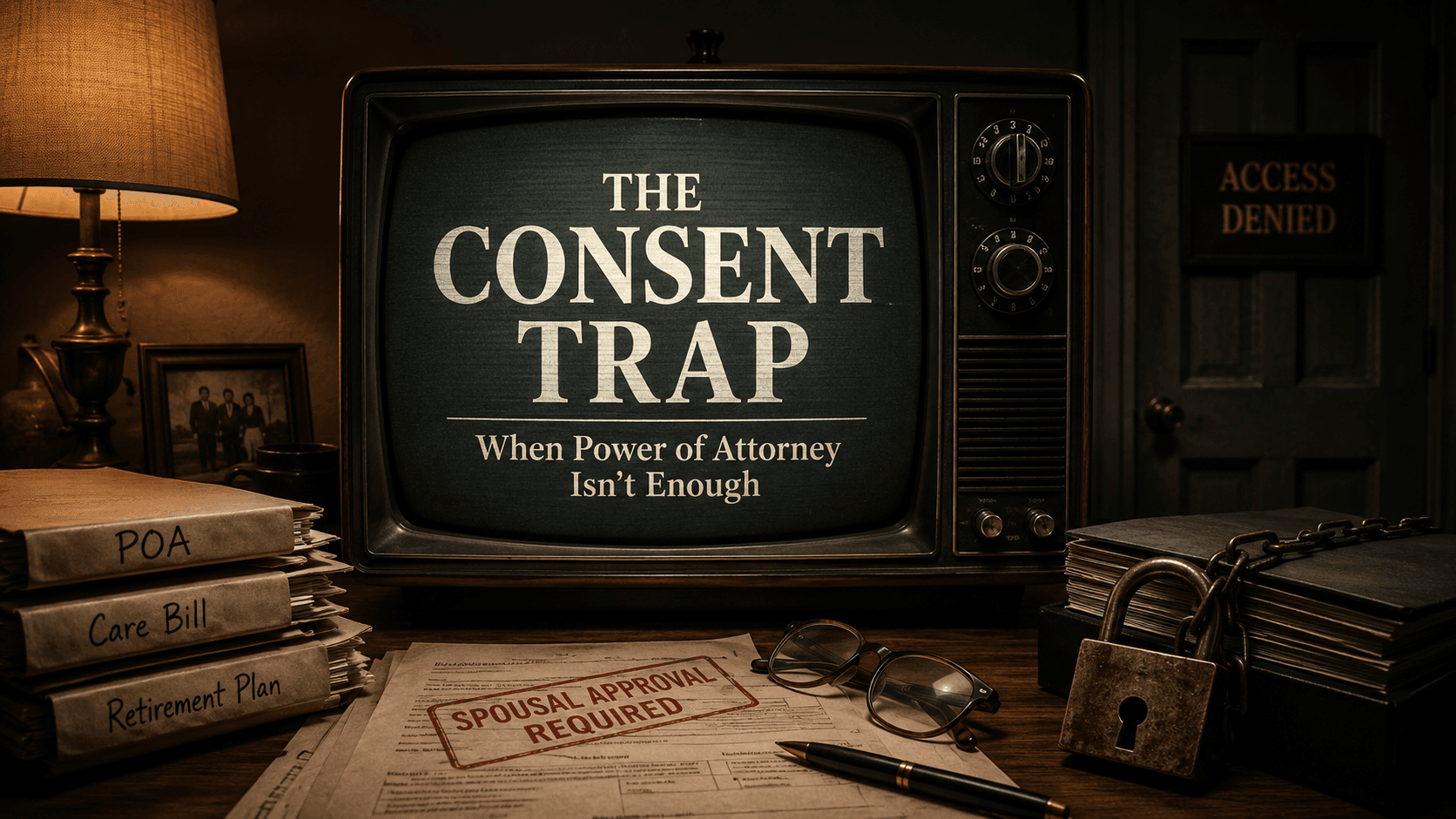
Dementia families are asked for consent constantly.
Consent to share information. Consent to treatment. Consent to care plans. Consent to access records. Consent to move money, manage accounts, change routines, accept help, refuse help, sign here, initial there, agree to terms, acknowledge receipt, waive this, authorize that.
It sounds tidy.
It isn’t.
Because in dementia care, consent is not just a signature. It is timing, capacity, pressure, fear, comprehension, family dynamics, institutional language, and the small matter of whether the person being asked truly understands what is being handed to them.
This is why I’m bringing The Consent Trap into MiM.
Families do not need more forms pretending to be clarity. They need plain language, better questions, and enough breathing room to understand what they are being asked to give away.
Consent should protect people.
Too often, it protects the system.
The word “consent” sounds comforting
Consent sounds civilized.
It sounds ethical.
It sounds like everyone has been informed, everyone has understood, everyone has had time to think, and everyone has made a free choice.
Lovely.
Now let’s bring that word into the real world, where a spouse is exhausted, an adult child is frightened, the person with dementia is trying to appear more capable than they feel, and someone with a clipboard is waiting for a signature.
That is where the trouble begins.
Because consent under pressure is not the same thing as consent with understanding.
Consent when someone is frightened is not the same thing as consent when someone is calm.
Consent when a family believes there is no other option is not the same thing as genuine choice.
And consent from someone with cognitive changes may require much more care, context, and protection than a standard form can provide.
But the system loves a signature.
A signature is neat. Portable. Defensible. Scanable. Uploadable. Easy to store in a file and produce later as proof that everything was properly explained.
Except sometimes it wasn’t.
Sometimes the person signed because they were scared.
Sometimes they signed because they trusted the professional in front of them.
Sometimes they signed because nobody explained the long-term consequences.
Sometimes they signed because their spouse said, “I think we have to.”
Sometimes they signed because the words were impossible to decode, and everyone in the room was pretending otherwise.
And sometimes they signed because the system needed a form more than the family needed clarity.
Dementia changes the consent conversation
Dementia does not remove a person’s humanity.
It does not erase their preferences, dignity, personality, rights, or voice.
But it can affect memory, judgment, processing speed, language, attention, spatial awareness, emotional regulation, and the ability to understand consequences.
That means consent cannot be treated as a checkbox.
It has to be treated as a process.
Can the person understand what is being proposed?
Can they understand the risks?
Can they understand the alternatives?
Can they explain the choice back in their own words?
Can they hold the information long enough to make a decision?
Can they make that decision without being pressured, rushed, or frightened?
Those are not fussy academic questions. They are the guardrails.
And in dementia care, guardrails matter.
Because the family may be navigating medical decisions, financial arrangements, home care, long-term care, legal documents, facility admissions, privacy releases, bank access, driving decisions, medication changes, and care plans.
Each one may involve “consent.”
Each one may carry consequences.
And each one may be presented during a moment when the family is least equipped to slow down and ask the better questions.
Which is exactly why they must.
“Just sign here” is not a care plan
Families hear it constantly.
Just sign here so we can speak with your spouse.
Just sign here so we can release the records.
Just sign here so we can set up care.
Just sign here so we can process the application.
Just sign here so we can move forward.
Just sign here.
That phrase should come with flashing lights.
Not because every form is dangerous. Many are necessary. Some are helpful. Some genuinely protect the person and family.
But “just sign here” is often where complexity goes to hide.
What exactly are we authorizing?
Who gets access?
For how long?
Can this be revoked?
Does this affect decision-making authority?
Does this create financial responsibility?
Does this limit future options?
Does this transfer control?
Does this allow information sharing beyond what we intend?
Does this assume capacity where capacity may be in question?
Does this protect the person, the family, the provider, or the institution?
That last question matters.
Because sometimes the answer is not flattering.
Informed consent requires being informed
This seems obvious enough to be embarrassing.
And yet, here we are.
Informed consent requires actual information.
Not a packet.
Not a portal message.
Not a twelve-page form written in the soothing language of institutional self-protection.
Information.
Plain language.
Enough time.
A chance to ask questions.
A chance to say, “I don’t understand.”
A chance to involve a trusted person.
A chance to speak with an attorney, physician, financial advisor, elder law professional, or advocate when the issue is serious enough to warrant it.
For families dealing with dementia, this matters even more.
Because the person may be masking symptoms.
The caregiver may be overwhelmed.
The family may be trying to avoid conflict.
And everyone may be operating under the quiet pressure of fear.
Fear makes people sign things.
Fear makes people agree to things.
Fear makes people accept false choices.
Fear makes people confuse movement with progress.
The system knows this, even when it pretends not to.
Capacity is not a light switch
One of the most dangerous misunderstandings in dementia care is the idea that capacity is either fully present or fully gone.
It is not that simple.
A person may be able to choose what they want for lunch but not understand a complex legal document.
They may be able to express preferences but not evaluate long-term financial risk.
They may appear socially fluent but struggle with processing details.
They may sound perfectly capable in a short conversation but become lost when decisions involve sequence, abstraction, or consequences.
They may have good days and bad days.
They may understand something at 10 a.m. and be confused by 4 p.m.
They may agree in the moment and have no memory of it later.
This is why capacity should be treated with care, not assumptions.
And it is why families need to document, discuss, and plan early, while the person can still participate meaningfully.
Not because we are stripping them of agency.
Because we are trying to preserve it.
There is a world of difference.
The family often gets trapped too
The person with dementia is not the only one at risk in the consent trap.
Families get pulled in as well.
A spouse may sign something because they believe it is required.
An adult child may agree to something without understanding the financial implications.
A caregiver may become the “responsible party” without knowing what responsibility they have just accepted.
A family may authorize access, placement, medication, billing, or services without fully understanding what happens next.
And later, when something goes wrong, the system points to the signature.
There it is.
Proof.
The paper says you agreed.
But agreement without understanding is not the moral victory people seem to think it is.
It is paperwork wearing a halo.
Questions families should ask before signing
When dementia is involved, families need a pause button.
Before signing anything important, ask:
What is this document for?
Who benefits from this authorization?
What happens if we do not sign today?
Can we take this home and review it?
Can we speak with someone who can explain it in plain language?
Does this create any financial responsibility?
Does this affect legal authority or decision-making?
Does this share medical, financial, or personal information?
How long does this consent last?
Can it be revoked?
Who should receive a copy?
Should an attorney, elder law professional, physician, or trusted advisor review this first?
These are not difficult questions.
They are protective questions.
And if asking them irritates someone, that is useful information.
Not always proof of wrongdoing, of course. Sometimes people are simply busy, undertrained, or trapped inside their own bureaucratic hamster wheel.
But if a system cannot tolerate basic questions, it has no business asking vulnerable families for trust.
Consent should not be used to transfer burden
Too often, families are handed responsibility without support.
They are told to consent, authorize, manage, supervise, coordinate, track, call, follow up, appeal, organize, transport, pay, decide, advocate, and somehow remain cheerful.
Preferably while sleeping four hours a night and Googling symptoms at 2:17 a.m.
Consent becomes the mechanism by which the system transfers burden to the family.
You agreed.
You authorized.
You accepted.
You signed.
But families cannot consent their way into competence when nobody has trained them.
They cannot consent their way into safety when no one has built a care structure.
They cannot consent their way into clarity when every form is written like it was assembled by a committee of lawyers hiding in a filing cabinet.
And they should not be expected to.
This is why MiM exists
MiM Memory in Motion is not a legal service.
It is not a medical service.
It is not here to replace clinicians, attorneys, elder law advisors, care managers, or family decision-makers.
MiM is here because there is a gap between diagnosis and daily life, and families are falling into it.
The consent trap lives inside that gap.
It appears when families do not yet know what questions to ask.
It appears when the person is still capable in many ways, but the world around them has started treating them either as fully independent or fully incapable, with very little useful space in between.
It appears when caregivers are asked to make decisions before they understand the terrain.
It appears when systems speak fluent bureaucracy and families speak panic.
MiM’s purpose is to help families build rhythm, routine, context, communication, and dignity early, before crisis starts making all the decisions.
Because the earlier we create clarity, the less vulnerable families are to pressure.
And the more we preserve the person behind the diagnosis.
The real question
The real question is not, “Did someone sign?”
The real question is, “Did they understand?”
Did they have time?
Were they pressured?
Were they capable of making that specific decision at that specific moment?
Were alternatives explained?
Were consequences explained?
Was the family supported?
Was the person’s dignity preserved?
Was consent used as protection, or as cover?
That is the difference.
And it matters.
Because in dementia care, signatures can shape lives.
They can open doors.
They can close doors.
They can protect people.
They can expose people.
They can preserve agency.
They can quietly remove it.
So no, this is not just paperwork.
It is dignity.
It is risk.
It is family protection.
It is one more place where we need to stop pretending that a form is the same thing as understanding.
Consent should never be a trap.
But too often, it is.
And families deserve to see it before the floor gives way.
Originally published on Substack as The Consent Trap and adapted here for MiM Memory in Motion, where we focus on the gap between diagnosis and daily life.