Shingles Vaccine and Dementia Risk: What Families Should Ask Their Doctor
VS
This article is not medical advice. It is a practical guide to help families ask better questions of their doctor, neurologist, nurse practitioner, or pharmacist.
The Dementia Vaccine Headline Came From Wales. Of Course I Had Questions.
I do not subscribe to Apple News.
This is not a moral position. I am not standing at the gates of journalism with a clipboard and a whistle. It is just one of those modern subscription jungles where everything wants $9.99 a month and a piece of your immortal soul.
But the preview gave me enough.
BBC. Wales. Stanford. Dementia vaccine.
That is the sort of breadcrumb trail you do not ignore, especially when you are building Memory in Motion, living with the daily reality of cognitive decline in your own home, and happen to have started life as Welsh.
Once Welsh, always Welsh, I suppose, although I am now a fully fledged, passport-carrying American. I even say “sidewalk” without needing a small lie-down afterward.
Let’s not get carried away.
I still say tom-ahh-toe, not tom-ay-toe. I still hesitate between garage and garage, because apparently even buildings for cars require an accent strategy. Petrol became gas. The boot became the trunk. The bonnet became the hood. Somewhere along the way, I became bilingual in two versions of English, which is less impressive than it sounds and mostly involves pausing before asking anyone where they put the spare tire.
And despite being Welsh by birth, I do not have the Welsh lilt people expect. Think Anthony Hopkins. Think Catherine Zeta-Jones. I have the dulcet tones of a Brit, because my parents paid quite a lot for me not to.
So yes, when the words BBC, Wales, Stanford, and dementia vaccine appeared in the same Apple News preview, I paid attention.
Off I went, not into Apple News, but into research mode with my friendly GPT assistant, because if the internet is going to throw a sentence like “dementia vaccine” at me before breakfast, the least it can do is explain itself.
What I found was not a miracle cure.
It was more interesting than that.
The story centers on the shingles vaccine and a major research trail that led through Wales. Because of the way the shingles vaccine was rolled out there, researchers were able to compare people who were very similar in age but fell on different sides of the eligibility line.
In other words, Wales accidentally handed science one of its better measuring sticks.
And that matters.
Because in health research, the devil often hides in the cardigan drawer. People who get vaccines may also be more likely to see doctors, eat better, exercise, take medication properly, and generally behave like people who alphabetize their spice rack. So when vaccinated people do better, the question is always: was it the vaccine, or was it the life around the vaccine?
The Welsh data helped cut through some of that fog.
The researchers found that people who received the shingles vaccine appeared to have a lower risk of being diagnosed with dementia over the following years. One large study reported about a one-fifth reduction in the probability of a new dementia diagnosis over seven years.
That is not nothing.
It is also not a magic wand.
And this is where we need to stay grown-up.
This does not mean we now have a proven dementia vaccine.
It does not mean shingles vaccination prevents Alzheimer’s.
It does not mean your doctor is hiding the cure in the bottom drawer between tongue depressors and outdated pamphlets about cholesterol.
It means serious researchers found a strong and intriguing signal. It means the question is worth asking. It means families deserve plain language, not carnival-barker headlines dressed up as science.
And yes, before the vaccine skeptics arrive with folding chairs, laminated talking points, and the phrase “do your own research” polished to a high shine, let me say this clearly.
Questions are allowed.
Questions are necessary.
Informed consent matters. Medical history matters. Side effects matter. Trust matters. People are allowed to ask what is known, what is not known, and whether a particular vaccine is appropriate for them or for someone they love.
That is not the problem.
The problem is when questions become a costume for certainty.
The problem is when skepticism stops being curiosity and turns into a locked room with the windows painted shut.
The problem is when families who are already frightened by dementia are handed either fairy dust or fear, when what they actually need is evidence, context, and a doctor willing to say, “Here is what we know. Here is what we do not know yet. Here is what I would consider in your case.”
That is the conversation we should be having.
Which brings me to the question families like mine actually ask:
What the hell does my doctor know about this?
And by “doctor,” I mean the whole sensible chain of care: primary care physician, neurologist, nurse practitioner, pharmacist, whoever actually knows your medical history and whether Shingrix is appropriate for you.
Because most families are not sitting around waiting for another academic paper. We are trying to figure out what to do on a Tuesday.
Should we ask about Shingrix? Yes.
Should we ask whether our spouse, parent, or partner has had both doses? Yes.
Should we ask whether there is any medical reason not to get it? Absolutely.
Should we pretend this is now proven dementia prevention? No.
That is how hope gets mugged by hype.
The CDC already recommends two doses of Shingrix for adults 50 and older to prevent shingles and related complications. That recommendation stands on its own, even before anyone mentions dementia. The dementia research adds an important question, not a final answer.
And that distinction matters.
So here is the question I would take to the doctor:
“Am I, or is my loved one, up to date on the shingles vaccine? And given the emerging research around shingles vaccination and dementia risk, is there any medical reason we should not complete the recommended two-dose series?”
That is not dramatic.
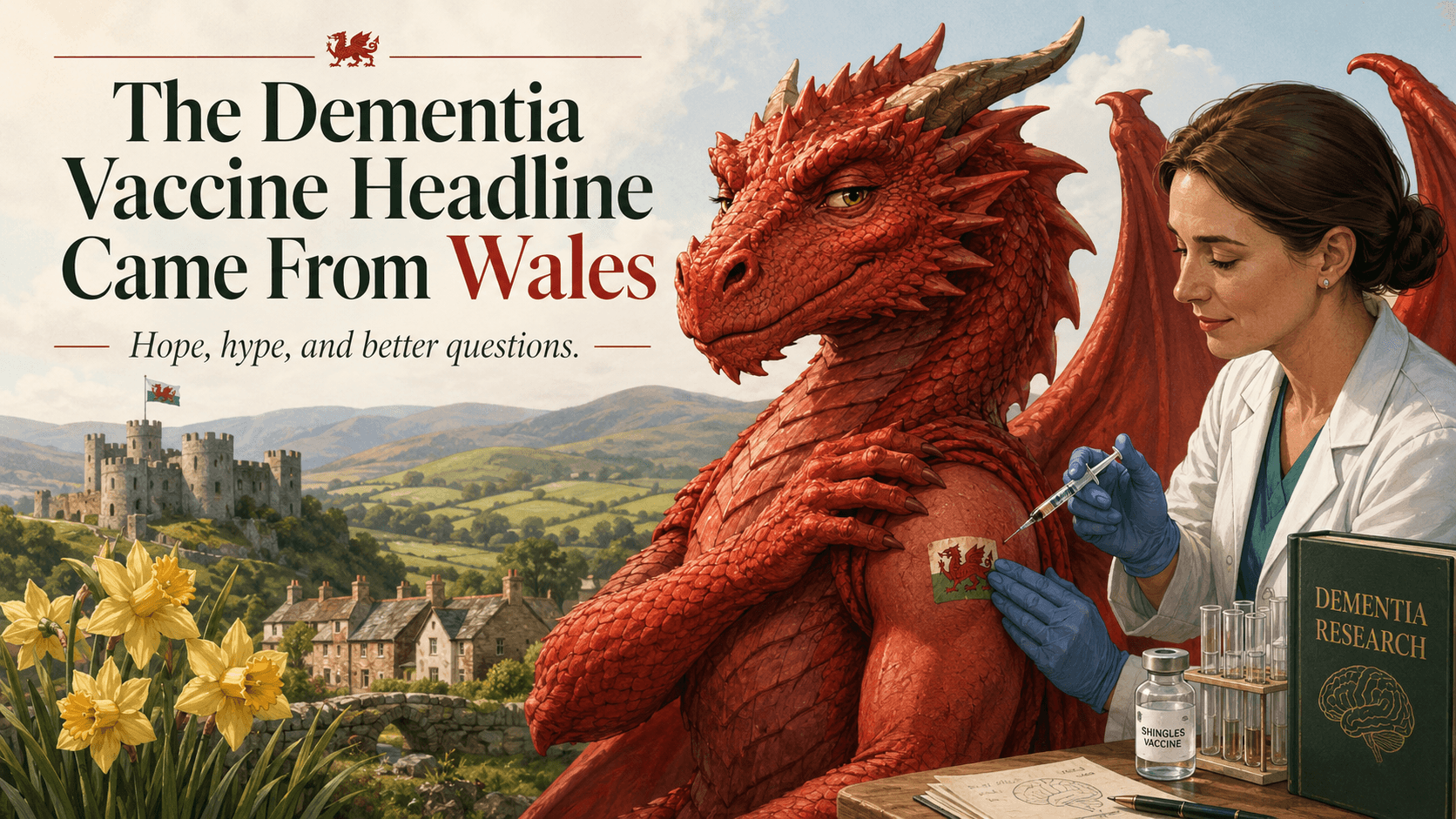
It will not trend as well as “Dementia Vaccine Found in Wales,” although honestly, that headline does have a certain dragon-breath drama to it.
But it is useful.
And useful matters.
Because families living with dementia do not need another headline that makes hope do cartwheels before collapsing in the car park. We need better questions. We need better conversations with our doctors. We need practical next steps that sit somewhere between “nothing can be done” and “please buy this miracle in gummy form.”
This is where Memory in Motion lives.
Not in panic.
Not in fairy dust.
In the gap between emerging science and ordinary families trying to make one decent decision at a time.
Built to Remember. Designed to Care.