
Music Is Not Background Noise When Memory Begins to Change
VS
Music Is Not Background Noise When Memory Begins to Change
This week, I had a conversation with Dan Cohen, founder of Music & Memory and Right to Music, and the subject of the Sundance award-winning documentary Alive Inside.
I reached out to Dan because MiM Memory in Motion is being built in the space after diagnosis but before traditional “care” begins.
That space is far too empty.
Families are often given warnings, pamphlets, risk language, medication discussions, future planning advice, and sometimes a rather bleak tour of everything that may go wrong.
What they are not always given is a way to keep daily life connected.
A way to preserve identity.
A way to support the person who is still very much here.
That is where music belongs.
Not as entertainment.
Not as a pleasant add-on.
Not as something nice to do if there is time after all the serious things have been handled.
Music may be one of the serious things.
Dan said something during our conversation that stopped me in my tracks.
The power of music is not really about genre.
It is about familiarity.
That sounds simple, but it changes everything.
It is not about whether someone liked classical music, country music, hymns, jazz, Motown, the Beatles, Welsh choirs, marching songs, disco, opera, or whatever was playing in the car during the summer of 1978.
The question is not, “What kind of music did they like?”
The better question is, “What music was theirs?”
What song did they dance to?
What song played at their wedding?
What did they sing in school?
What did their mother hum in the kitchen?
What was on the radio when they were driving to work, falling in love, leaving home, raising children, surviving grief, finding themselves, or becoming themselves?
That music is not background noise.
It is an access point.
It is attached to story, rhythm, place, identity, and emotional memory.
And here is the part that matters deeply for MiM.
We need to ask these questions early.
Not when the person is already in late-stage disease.
Not when the family is exhausted and trying to reconstruct a life from fragments.
Not when everyone is standing around saying, “I wish we had known.”
We need to ask while the person can still tell us.
Because too often, families do not know.
A daughter may know her mother’s medical history, medication list, insurance details, and appointment schedule, but not the songs that made her mother feel most alive.
A spouse may know every pharmacy refill and still not know the music that unlocks a memory.
That is not a failure of love.
It is a failure of systems.
Our health and care systems are not built around the preservation of personhood. They are built around diagnosis, risk, crisis, billing codes, referrals, and eventually care plans.
But life is not a care plan.
Life is mornings, habits, smells, music, jokes, arguments, recipes, walking routes, favorite chairs, family sayings, songs in the car, and the thousand tiny rituals that tell a person: this is me, this is mine, I am still here.
That is why MiM exists.
MiM is not medical care. It does not diagnose, treat, or promise to slow disease. It is not here to pretend dementia can be solved with a playlist and a positive attitude. That would be insulting, and frankly, dangerous.
But MiM is here to take daily life seriously.
To support the gap between diagnosis and dependency.
To help Travelers and Supporters build practical scaffolding around identity, routine, movement, connection, safety, and memory.
And music belongs in that scaffolding.
Not vaguely.
Not as “play something cheerful.”
Not as “put on oldies.”
Personalized music has to be personal.
Dan talked about the danger of settling for a weak response and calling it success. If someone seems calmer when generic music is playing, that may be useful. But it may also be only a fraction of what is possible if the music is truly familiar, truly connected, truly theirs.
That distinction matters.
Because we do this in dementia care all the time.
We accept less.
A person smiles once, and we call it engagement.
A person sits quietly, and we call it calm.
A person stops objecting, and we call it success.
But what if the real goal is not just reduced distress?
What if the goal is recognition?
Connection?
Agency?
Pleasure?
A moment of self returning to the surface?
There is a cruelty in assuming that because someone has memory loss, the details no longer matter.
The details may matter more than ever.
The right song is not magic.
But it may be a bridge.
And bridges matter when the terrain is changing.
One of the clearest lessons from my conversation with Dan is that we should not wait. We should not wait until the crisis. We should not wait until the move. We should not wait until the family is searching drawers, old CDs, Spotify accounts, church programs, wedding albums, and half-remembered stories.
Ask now.
Ask gently.
Ask with curiosity.
What song reminds you of your childhood?
What music did your parents play?
What did you listen to when you were fifteen?
What did you play when you first drove a car?
What song did you dance to when no one was watching?
What hymn, anthem, lullaby, marching song, folk song, pop song, or ridiculous guilty pleasure still makes you smile?
And then write it down.
Save it.
Build the playlist.
Tell the story behind the song.
Because the playlist alone is not the whole point.
The story is the point.
The person is the point.
After my conversation with Dan, we did what you should probably never do when you have just had a meaningful conversation about technology, music, and memory.
We tried it immediately.
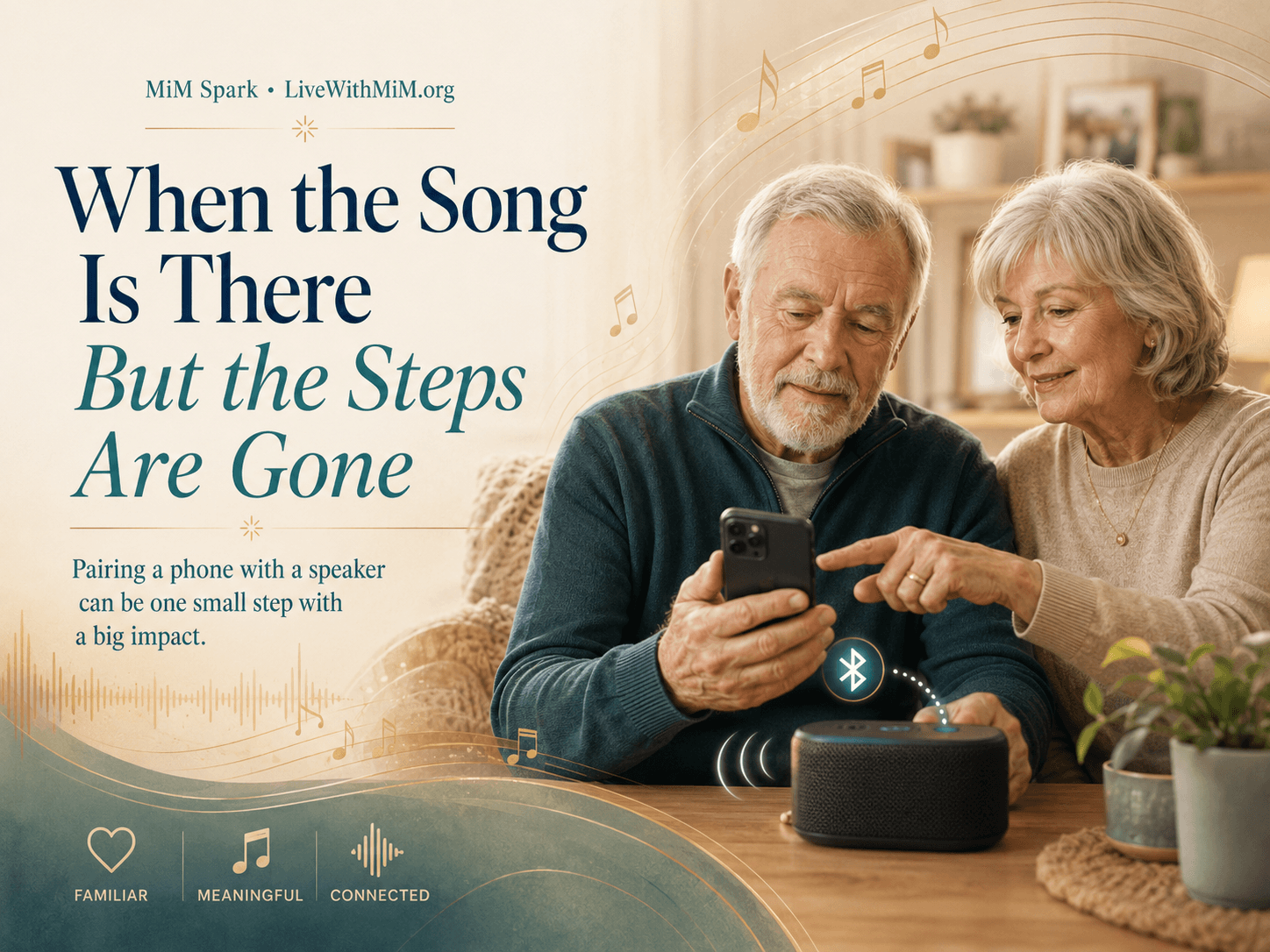
And immediately discovered that Tim had forgotten how to connect his iPhone to our Bluetooth speakers.
Not forgotten the music.
Not forgotten what he wanted to hear.
Forgotten the little invisible bridge between phone and speaker.
And there it was, in miniature: the gap MiM keeps talking about.
The music was available. The technology was available. The desire was there. But one small sequence of steps had slipped out of reach.
So we went through it again.
Slowly.
Without making it a test.
Without turning it into one of those awful “Do you remember how to do this?” moments that make everyone feel as if they are standing in front of a blackboard in the wrong classroom.
We relearned it together.
For anyone who needs the basic version, here it is.
On an iPhone:
Open Settings.
Tap Bluetooth.
Make sure Bluetooth is turned on.
Turn on your speaker and put it in pairing mode. Usually this means holding the Bluetooth button until a light flashes blue.
Look under Other Devices or My Devices on the phone.
Tap the name of your speaker.
Once it says Connected, open Apple Music, Spotify, YouTube, or whatever music app you use.
Play the song.
That is it.
Small steps. Big difference.
And once it is connected, the real magic is how easy it has become to call up old favorites.
You can ask Siri.
“Hey Siri, play the Beatles.”
“Hey Siri, play music from 1972.”
“Hey Siri, play Welsh male voice choirs.”
“Hey Siri, play our wedding song.”
You can ask Alexa the same way.
“Alexa, play Motown from the 1960s.”
“Alexa, play Frank Sinatra.”
“Alexa, play songs from when I was a teenager.”
This is not technology for technology’s sake.
This is technology finally doing something useful.
For once, the little glowing rectangles and listening cylinders can earn their keep.
Because if a familiar song can help someone reconnect with a memory, a feeling, a story, or simply a better morning, then why would we not use the tools sitting right there on the counter?
This may need its own MiM Spark piece, because there is a whole practical conversation to be had about making music easier to access before it becomes difficult.
Not later.
Now.
Next up, I am going to watch Alive Inside, the Sundance award-winning documentary featuring Dan Cohen’s work, and take it from there.
Because this conversation did not feel like a conclusion.
It felt like a door opening.
If personalized music can help families reconnect with the person beyond the diagnosis, then it deserves to be part of the early conversation, not something discovered later by accident, desperation, or regret.
This is where I believe MiM can help.
Not by turning music into another task on a dementia checklist, but by making it part of a living memory structure. A way to preserve preferences, routines, emotional anchors, and moments of connection before they are needed in crisis.
A diagnosis should not mean disappearance.
And support after diagnosis should not begin with fear alone.
It should begin with the person.
Their songs.
Their rhythms.
Their stories.
Their life, still in motion.