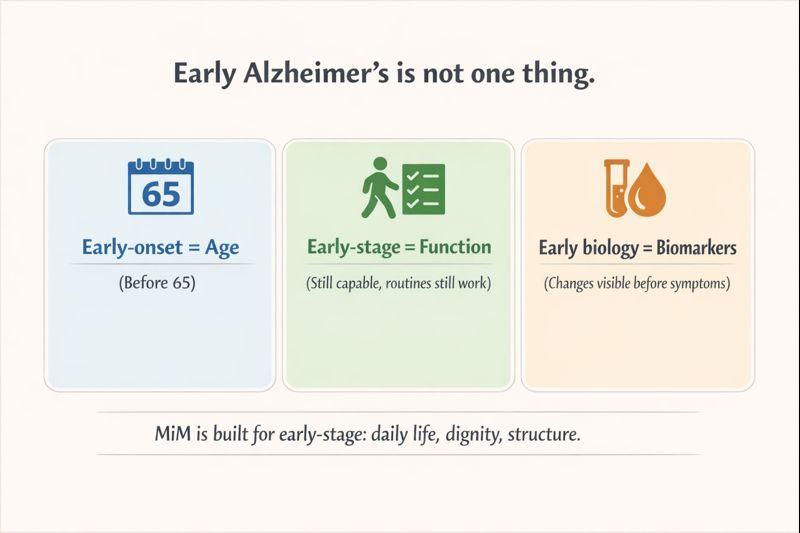
Three “Earliest” That People Confuse (and Families Pay For)
People keep saying “early Alzheimer’s” like it’s one thing.
It’s not.
It’s three different things wearing the same label, and that confusion is one of the reasons families get diagnosed… then sent home to live life not knowing what to do next.
So here’s the clarifier, in plain English, without the medical fog machine.
1) Early-onset is about age Early-onset Alzheimer’s means symptoms begin before 65.
That’s it. It’s a calendar label, not a severity label.
Early-onset doesn’t automatically mean faster. It doesn’t automatically mean worse. It means “this showed up younger than expected.”
2) Early-stage is about function Early-stage Alzheimer’s is about what a person can still do.
It means mild symptoms, still capable, still participating in life, still able to build routines, still able to make choices. Often still independent or semi-independent, especially with the right support.
A person can be 74 and early-stage. A person can be 58 and not.
Stage is function, not birthday candles.
3) Early biology is about what’s happening under the hood This is where blood biomarkers and PET scans matter.
They can show Alzheimer’s biology earlier than symptoms do. Not as a fortune teller. As a flashlight.
They don’t “predict your future.” They can reveal what is happening now, early enough for a clinician to discuss options, risk reduction, and (for some people) treatment pathways.
So yes: waiting for symptoms is how prevention time gets lost.
But here’s the part I’m building MiM around, because it’s the part families actually live:
The real gap is after diagnosis Once someone gets diagnosed, the system is built for medicine.
It is not built for daily life.
You’ll get pamphlets, appointments, maybe a prescription, and a follow-up that feels like it was scheduled by a calendar that has never met a human being.
What you don’t get is a plan for everyday living.
MiM exists because that gap is where fear expands. It’s where families hover. It’s where the person living with changes starts to feel like a problem to be managed instead of a person to be supported.
MiM is the bridge between diagnosis and daily life.
Not medical care. Not a tracker. Not a patronizing reminder app.
A dignity-forward operating system for the early-stage window, when structure can still protect independence and dignity.
What MiM does (in real terms) MiM gives Travelers simple Daily Prompts they can actually do and tap Done. MiM gives Supporters a calm system to set the rhythm without turning the relationship into supervision.
It’s kitchen-table simple: movement, meals, meds prep, sleep, mood check-ins, moments that matter, and gentle coordination that reduces avoidable stress.
Because “early” is not when symptoms become inconvenient.
Early is when biology is visible and function is still steerable.
That’s the window where we can keep life feeling like life.
If you’re a Supporter reading this: Ask the medical questions. Track what matters. Build structure early. Do not wait for crisis mode to become your default setting.
And if you want the bridge, not just the diagnosis: MiM is here.