
The Cruelty of “Natural Cures”

VS

Feb 25, 2026By Vanessa Saunders


Yesterday I saw a post on LinkedIn claiming researchers had “reactivated the brain’s cleaning system” and watched Alzheimer’s plaques “vanish,” revealing a “natural cure.”

It looked polished. Professional. Confident.

No citation.
No journal.
No DOI.
No clarification whether this was tested in humans.

Just certainty.

Someone in the comments asked the most reasonable question possible:
“Is there any data behind this yet?”

The account owner, Sima A., who presents herself as a Founder and CEO in AI research, did not provide a study.

She replied:

Thank you.

And again.

Thank you.

Every comment. Same response. No evidence.

I cannot definitively prove the account is automated. But the behavior was consistent with engagement farming. Sensational claim. Rapid likes. Generic replies. No sources.

Luckily, I snapped a screenshot, reported the misinformation, and the post was taken down quickly.

But not before the likes climbed.

That’s the part that matters.

False hope moves faster than correction.

Now let’s talk about how I evaluate claims like this.
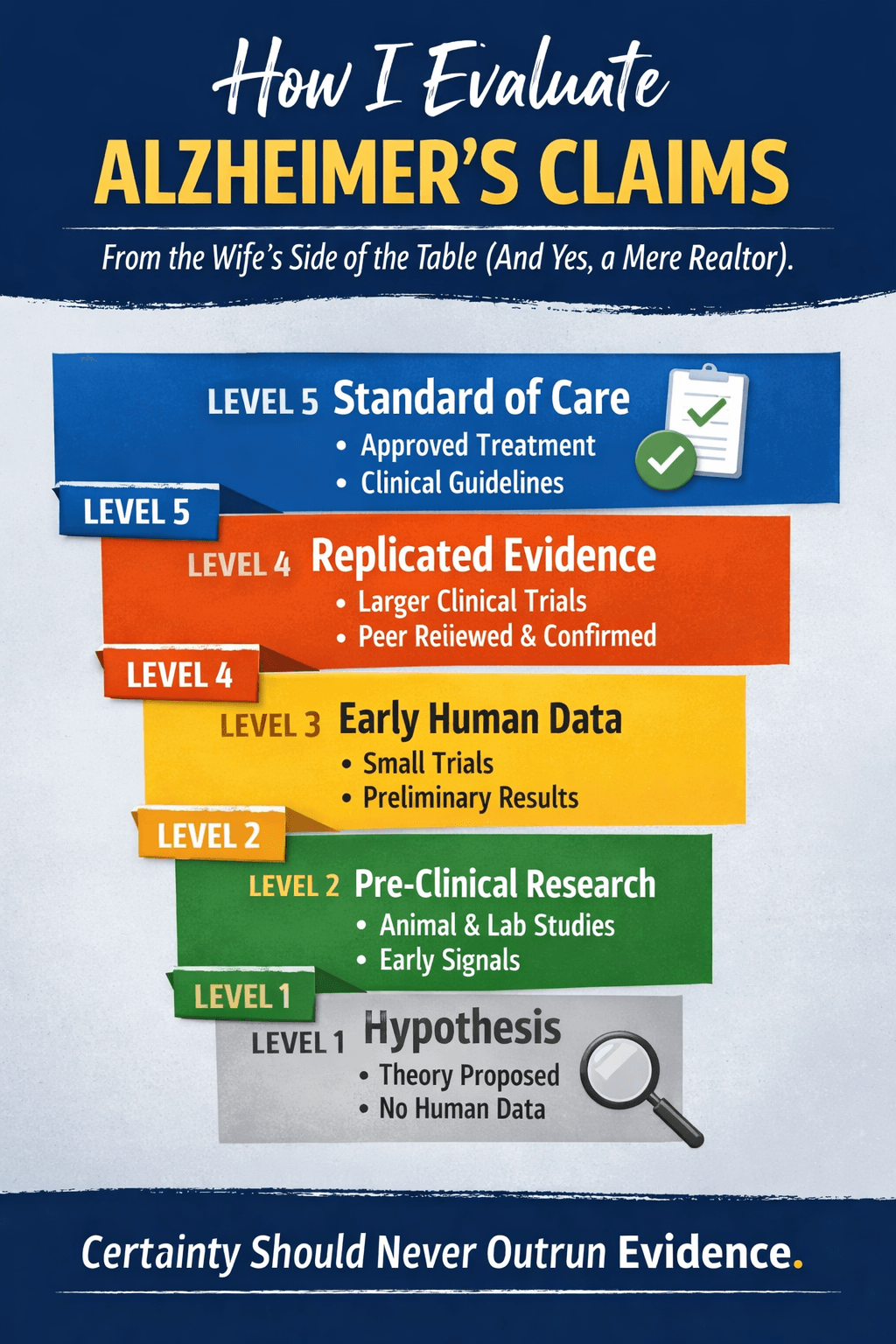
When I see a breakthrough, I ask one question:

Where does this sit on the ladder?

Level 5. Approved treatments and clinical guidelines.
Level 4. Replicated evidence in large human trials.
Level 3. Early human data.
Level 2. Animal or lab studies.
Level 1. Hypothesis.

“Plaques vanish” is Level 5 language.

Without a citation, it does not even qualify as Level 2.

The gap between tone and evidence is where cruelty lives.

Families navigating Alzheimer’s are not casual readers. They read because they are scared. They read because they are trying to protect someone they love. They read at night when the house is quiet and the fear is loud.

Dropping the words natural cure into that space without proof is not optimism.

It is emotional extraction.

I am not a scientist.

I am a wife.

And from the wife’s side of the table, certainty without evidence feels like theft.

If you see a “breakthrough,” ask three things:

Where is the peer reviewed paper
Was it tested in humans
Has it been replicated

If those answers are not there, it belongs at Level 1 or Level 2.

Not in a meme.

Certainty should never outrun evidence.

And Alzheimer’s families deserve better than Thank you.